---
title: "Architecting Ultra-Realistic 3D Avatars with React, MongoDB, and AWS"
description: "This blog explains how to turn a single photo into a realistic, animatable 3D avatar using SMPL-X and PIFuHD models. It outlines a full-stack pipeline with React + Three.js for web previews, MongoDB Atlas for metadata, and AWS for storage, compute, and delivery. The final output is a compact GLB…"
url: https://lidvizion.ai/blog/architecting-ultra-realistic-3d-avatars-with-react-mongodb-and-aws/
site: Lid Vizion
index: https://lidvizion.ai/llms.txt
---
[Insights](https://lidvizion.ai/blogs/) Architecture & Orchestration 12 min read 2025-02-01
# Architecting Ultra-Realistic 3D Avatars with React, MongoDB, and AWS
This blog explains how to turn a single photo into a realistic, animatable 3D avatar using SMPL-X and PIFuHD models. It outlines a full-stack pipeline with React + Three.js for web previews, MongoDB Atlas for metadata, and AWS for storage, compute, and delivery. The final output is a compact GLB…
By [Lamar Giggetts](https://lidvizion.ai/author/lamar-giggetts/) [Architecture & Orchestration](https://lidvizion.ai/blog-categories/architecture-orchestration/)
Tags: [3D Avatar Generation](https://lidvizion.ai/tags/3d-avatar-generation/), [Image Retrieval Augmented Generation](https://lidvizion.ai/tags/image-retrieval-augmented-generation/), [MongoDB Atlas Vector Search](https://lidvizion.ai/tags/mongodb-atlas-vector-search/), [AWS Lambda](https://lidvizion.ai/tags/aws-lambda/)
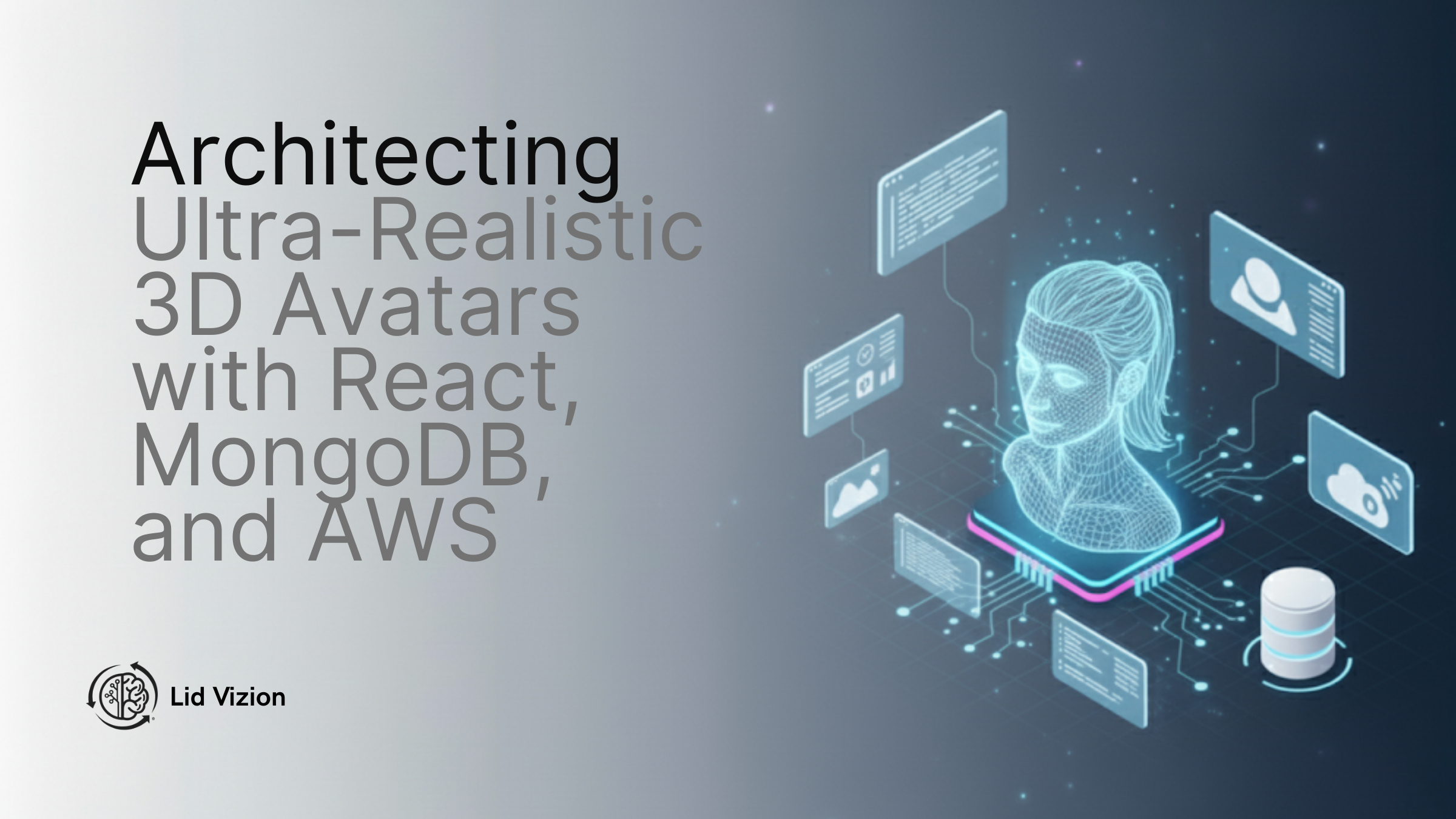
Turning a single photo into a lifelike, animatable 3D avatar is now practical for consumer apps. The recipe: **SMPL-X** to recover full-body pose/shape/face from an image, **PIFuHD** to reconstruct high-detail geometry and texture, a **React + Three.js (react-three-fiber)** viewer, **MongoDB** for user/asset metadata, and **AWS** for storage, compute, and global delivery. The output ships as a compact **GLB** (glTF binary) for snappy, web-native rendering ([SMPL-X](https://smpl-x.is.tue.mpg.de/), [PIFuHD](https://github.com/facebookresearch/pifuhd), [GLB/glTF](https://resources.imagine.io/blog/gltf-vs-glb-which-format-is-right-for-your-3d-projects), [r3f docs](https://r3f.docs.pmnd.rs/tutorials/loading-models)).
**Use case:** let users upload a selfie/full-body photo and receive a personalized 3D avatar they can preview, pose, and share.
**Stack:** React + Three.js/r3f, MongoDB Atlas (or DocumentDB) for metadata, S3 for images/models, API Gateway + Lambda (or a thin EC2/containers API), GPU compute on EC2 (or Batch/SageMaker), CloudFront CDN. Security: HTTPS + S3 encryption at rest + least-privilege IAM ([S3 security](https://docs.aws.amazon.com/AmazonS3/latest/userguide/security-best-practices.html); also see [S3 TLS discussion](https://stackoverflow.com/questions/62676384/how-to-securely-store-images-on-amazon-s3)).
## Architecture at a glance
**S3/CloudFront (static SPA + models) → React (uploads + 3D viewer) → API (Lambda/EC2) → GPU pipeline (SMPL-X + PIFuHD) → S3 (GLB) → MongoDB (metadata)**
- **Frontend:** React SPA hosted on **S3 + CloudFront**; upload via **presigned URL**, render GLB with **react-three-fiber** ([r3f loader](https://r3f.docs.pmnd.rs/tutorials/loading-models)).
- **Storage:** All photos and GLBs in **S3**, encrypted at rest (SSE-S3/SSE-KMS) and in transit (HTTPS) ([S3 security](https://docs.aws.amazon.com/AmazonS3/latest/userguide/security-best-practices.html), [TLS note](https://stackoverflow.com/questions/62676384/how-to-securely-store-images-on-amazon-s3)).
- **Compute:** Event-driven orchestration (S3 event → Lambda/SQS/Step Functions). Heavy lifting on **GPU EC2** (e.g., **g4dn.xlarge** ~T4 GPU) or Batch/SageMaker ([g4dn pricing](https://instances.vantage.sh/aws/ec2/g4dn.xlarge)).
- **Models:** **SMPL-X** recovers parameters/skeleton/face; **PIFuHD** reconstructs high-res mesh/texture; mesh is **rigged** to SMPL-X, exported as **GLB** ([SMPL-X](https://smpl-x.is.tue.mpg.de/), [PIFuHD](https://github.com/facebookresearch/pifuhd), [GLB benefits](https://resources.imagine.io/blog/gltf-vs-glb-which-format-is-right-for-your-3d-projects)).
- **Metadata:** **MongoDB Atlas** (or DocumentDB) tracks users, upload keys, job status, model URIs. (See cost notes: [Atlas vs DocumentDB](https://www.vantage.sh/blog/documentdb-vs-mongodb-price-comparison).)
## End-to-end flow
1. **Upload & enqueue** The React app requests a **presigned S3 URL**, uploads the photo over HTTPS, and creates a `jobs` record in MongoDB (`userId`, `photoKey`, `status=pending`, …). S3 default encryption protects objects at rest; bucket policies block public reads ([S3 security](https://docs.aws.amazon.com/AmazonS3/latest/userguide/security-best-practices.html)).
2. **Kick off GPU job** An S3 `ObjectCreated` event triggers a Lambda that posts a message to **SQS** or starts a **Step Functions** workflow. The worker spins up a container on **EC2 GPU** (or **Batch**/**EKS** with GPU nodes).
3. **Reconstruction**
- **SMPL-X:** Estimate body shape/pose/hands/face to obtain a parametric mesh and skeleton ([SMPL-X](https://smpl-x.is.tue.mpg.de/)).
- **PIFuHD:** From the same image (optionally cropped using SMPL-X keypoints), generate a **high-resolution textured mesh** ([PIFuHD](https://github.com/facebookresearch/pifuhd)).
- **Fitting/rigging:** Fit PIFuHD geometry to the SMPL-X skeleton for animation.
- **Export:** Clean/retopologize as needed; export **GLB** (glTF binary, packs mesh + textures + animations efficiently for the web) ([GLB vs glTF](https://resources.imagine.io/blog/gltf-vs-glb-which-format-is-right-for-your-3d-projects)).
4. **Persist & notify** Upload the `.glb` to S3, update MongoDB (`status=ready`, `avatarKey`), and notify the client (WebSocket/push). The React app then loads the GLB from **CloudFront** for low-latency viewing.
## Web viewer (React + Three.js)
React-Three-Fiber makes GLB loading a one-liner:
`import { Canvas, useLoader } from '@react-three/fiber'` `import { GLTFLoader } from 'three/examples/jsm/loaders/GLTFLoader'` `function Avatar({ url }) {` `const gltf = useLoader(GLTFLoader, url)` `return ` `}` `export default function Viewer({ url }) {` `return (` `` `)` `}`
Docs: loading models with r3f’s `useLoader` ([r3f tutorial](https://r3f.docs.pmnd.rs/tutorials/loading-models)).
## Security & privacy checklist
- **HTTPS everywhere** (S3/CloudFront/API).
- **Encryption at rest**: enable default S3 SSE; consider **SSE-KMS** for stricter compliance ([S3 security](https://docs.aws.amazon.com/AmazonS3/latest/userguide/security-best-practices.html)).
- **Least-privilege IAM**: narrow roles per Lambda/EC2; block public access; prefer **presigned URLs** for upload/download ([S3 security](https://docs.aws.amazon.com/AmazonS3/latest/userguide/security-best-practices.html); [TLS upload note](https://stackoverflow.com/questions/62676384/how-to-securely-store-images-on-amazon-s3)).
- **Data minimization**: delete or archive raw photos after GLB creation if not needed.
## Performance & cost notes
**GPU compute**
- **g4dn.xlarge** (T4, 4 vCPU, 16 GB) ≈ **$0.53/hr on-demand**; **Spot** can be ~**$0.21/hr** depending on region ([g4dn pricing](https://instances.vantage.sh/aws/ec2/g4dn.xlarge)).
- Optimize: batch jobs, auto-scale GPU fleet, keep models warm, and decimate meshes/textures where quality permits.
**Storage & delivery**
- **S3 Standard** ≈ **$0.023/GB-mo** ([S3 pricing explainer](https://www.nops.io/blog/how-much-do-aws-s3-storage-classes-cost/)).
- **CloudFront egress** ≈ **$0.085/GB** in US/EU (first TB often free on Free Tier), perfect for distributing GLBs globally ([CloudFront pricing](https://aws.amazon.com/cloudfront/pricing/)).
**APIs & serverless glue**
- **Lambda**: **$0.20 per 1M requests** + **$0.00001667/GB-s**; 1M requests & 400k GB-s free each month—API costs are typically negligible for this workload ([Lambda pricing guide](https://www.cloudzero.com/blog/lambda-pricing/), also [AWS page](https://www.cloudzero.com/blog/lambda-pricing/)).
**Database**
- **MongoDB Atlas** vs **DocumentDB**: choose on price/operational fit; see side-by-side analysis ([Vantage comparison](https://www.vantage.sh/blog/documentdb-vs-mongodb-price-comparison)).
**Back-of-napkin example** (10k avatars/month, 10 MB each, 1 view/user):
- **GPU**: if 30 min per avatar → 5,000 GPU-hrs → ~$2.6k on-demand (or ~$1.0–1.2k spot) ([g4dn pricing](https://instances.vantage.sh/aws/ec2/g4dn.xlarge)).
- **S3 storage**: ~150 GB total (photos+GLBs) → **~$3.5/mo** ([S3 pricing](https://www.nops.io/blog/how-much-do-aws-s3-storage-classes-cost/)).
- **CDN egress**: 100 GB → **~$8.5/mo** (often covered by free tier starter) ([CloudFront pricing](https://aws.amazon.com/cloudfront/pricing/)).
- **API/Lambda**: pennies; usually inside free tier ([Lambda pricing](https://www.cloudzero.com/blog/lambda-pricing/)). _Conclusion:_ GPU time dominates; everything else is pocket change.
## Practical implementation tips
- **Mesh pipeline:** crop person via SMPL-X keypoints → PIFuHD → artifact cleanup → **fit to SMPL-X skeleton** → bake textures → export **GLB**.
- **Viewer UX:** show a placeholder, stream the GLB, and offer orbit/zoom + a few one-click poses (drive skeleton from SMPL-X joints).
- **Key management:** keep KMS CMKs for sensitive buckets; rotate per environment.
- **Versioning:** store `pipelineVersion` and `modelVersion` with each asset in Mongo to support reprocessing.
- **Cost control:** spot fleets for batch windows, queue smoothing, and mesh decimation/texture atlases for smaller GLBs.
- **Vendors:** you can swap in a partner (e.g., third-party avatar API) as a fallback path while your GPU jobs run.
## TL;DR
- **SMPL-X + PIFuHD** deliver photo→avatar realism from a single image ([SMPL-X](https://smpl-x.is.tue.mpg.de/), [PIFuHD](https://github.com/facebookresearch/pifuhd)).
- **GLB** is the right delivery format for the web—compact, streamable, and widely supported ([GLB/glTF](https://resources.imagine.io/blog/gltf-vs-glb-which-format-is-right-for-your-3d-projects)).
- **React + r3f** make in-browser previews trivial; host on **S3 + CloudFront** for speed ([r3f loader](https://r3f.docs.pmnd.rs/tutorials/loading-models)).
- **AWS + MongoDB** keep ops simple: S3 for assets, GPU EC2 for heavy compute, CloudFront for delivery, Atlas/DocumentDB for metadata.
- **Security by default:** HTTPS, S3 encryption, least-privilege IAM ([S3 security](https://docs.aws.amazon.com/AmazonS3/latest/userguide/security-best-practices.html)).
- **Costs:** storage/CDN/serverless ≈ negligible; **GPU time is the budget driver**—use batching and Spot.
## URL Index
1. SMPL-X (body/hands/face model) [https://smpl-x.is.tue.mpg.de/](https://smpl-x.is.tue.mpg.de/)
2. PIFuHD (high-res single-image reconstruction) [https://github.com/facebookresearch/pifuhd](https://github.com/facebookresearch/pifuhd)
3. GLB vs glTF for the web [https://resources.imagine.io/blog/gltf-vs-glb-which-format-is-right-for-your-3d-projects](https://resources.imagine.io/blog/gltf-vs-glb-which-format-is-right-for-your-3d-projects)
4. React-Three-Fiber: loading models [https://r3f.docs.pmnd.rs/tutorials/loading-models](https://r3f.docs.pmnd.rs/tutorials/loading-models)
5. S3 TLS uploads discussion [https://stackoverflow.com/questions/62676384/how-to-securely-store-images-on-amazon-s3](https://stackoverflow.com/questions/62676384/how-to-securely-store-images-on-amazon-s3)
6. S3 security best practices (encryption/IAM) [https://docs.aws.amazon.com/AmazonS3/latest/userguide/security-best-practices.html](https://docs.aws.amazon.com/AmazonS3/latest/userguide/security-best-practices.html)
7)–9),15) MongoDB Atlas vs Amazon DocumentDB: cost [https://www.vantage.sh/blog/documentdb-vs-mongodb-price-comparison](https://www.vantage.sh/blog/documentdb-vs-mongodb-price-comparison)
1. S3 storage pricing (primer) [https://www.nops.io/blog/how-much-do-aws-s3-storage-classes-cost/](https://www.nops.io/blog/how-much-do-aws-s3-storage-classes-cost/)
2. CloudFront pricing [https://aws.amazon.com/cloudfront/pricing/](https://aws.amazon.com/cloudfront/pricing/)
3. g4dn.xlarge pricing/specs [https://instances.vantage.sh/aws/ec2/g4dn.xlarge](https://instances.vantage.sh/aws/ec2/g4dn.xlarge)
13)–14) AWS Lambda pricing (requests + GB-s) [https://www.cloudzero.com/blog/lambda-pricing/](https://www.cloudzero.com/blog/lambda-pricing/)
[PreviousServerless Workflows and APIs for Computer Vision](https://lidvizion.ai/blog/serverless-workflows-and-apis-for-computer-vision/) · [NextMulti-Agent Orchestration for Vision Systems (LangChain + AWS)](https://lidvizion.ai/blog/multi-agent-orchestration-for-vision-systems-langchain-aws/)
Keep reading
## Related insights.
- [Efficient Data Retrieval from Images: Using LlamaIndex, Mongo, and AWS](https://lidvizion.ai/blog/efficient-data-retrieval-from-images-using-llamaindex-mongo-and-aws/): This blog explains how image-centric RAG improves search accuracy by indexing image embeddings directly instead of relying on captions. Using CLIP or VoyageAI models, MongoDB Atlas Vector Search, and LlamaIndex, it creates a low-cost, scalable pipeline where text or image queries can instantly…
- [Basketball Performance AI: Lightweight Video Analytics (with the Right Resources)](https://lidvizion.ai/blog/basketball-performance-ai-lightweight-video-analytics-with-the-right-resources/): A B2B playbook for basketball clubs, academies, leagues, and apps: build player/ball tracking, event tagging, and coach-ready insights with lightweight CV—plus a curated resource stack you can trust.
## Where does your workflow get stuck?
[Discuss the workflow](https://lidvizion.ai/contact/) · [Book a call](https://calendar.app.google/bB26LdA9e2gmGFp69)